Fine jewelry is entering a particularly interesting moment. The emphasis is shifting away from conventional ideas of luxury and toward pieces with greater individuality, character, and a sense of permanence. Diamonds are being reconsidered through antique cuts and unexpected proportions. Pearls are becoming more expressive. Colored gemstones, sculptural metals, and unconventional materials are finding their place alongside traditional precious stones.
For 2026, the most compelling fine jewelry trends share a common sensibility: a preference for distinctive objects over predictable statements. There is renewed interest in the irregularities of antique craftsmanship, the visual character of unusual gemstones, and the versatility of jewelry designed to be worn in different ways. Even familiar categories, from engagement rings to evening watches, are being approached with a more personal point of view.
Whether exploring diamond trends, looking for a distinctive engagement ring, or considering an investment in exceptional jewelry, these are 20 fine jewelry trends worth knowing in 2026.
1. Cabochon Diamonds: The Appeal of Smooth, Unfaceted Stones
One of the more unexpected developments in fine jewelry is the growing interest in cabochon diamonds. Unlike traditional brilliant-cut diamonds, which rely on carefully arranged facets to maximize sparkle, cabochon diamonds are polished into smooth, rounded surfaces.
The result is a different kind of luminosity. Rather than producing the sharp flashes of light associated with conventional diamond cuts, these stones offer a softer, more subdued appearance. Their appeal lies in their unusual finish, tactile quality, and departure from established diamond traditions.
Cabochon diamonds introduce an almost sculptural quality to fine jewelry. They are particularly compelling in substantial rings, contemporary settings, and designs that emphasize the natural character of the stone.
For collectors interested in diamonds beyond the traditional brilliant cut, this is a distinctive direction to watch.
2. Conch Pearls: A New Status Symbol in Fine Jewelry
Conch pearls are among the most extraordinary and collectible natural pearls. Produced by the queen conch mollusk, they are prized for their distinctive colors, porcelain-like surfaces, and characteristic flame structure.
Unlike conventional cultured pearls, conch pearls are exceptionally rare and cannot be commercially cultured in the same way. Their scarcity, combined with their unusual appearance, has made them particularly desirable among serious jewelry collectors.
Pink conch pearls are especially captivating. Their colors range from delicate blush to saturated coral pink, often with subtle variations that make each pearl unique.
Increasingly discussed as a 2026 status symbol, conch pearls represent a more discerning approach to luxury. They are recognizable to knowledgeable collectors without relying on the familiar visual language of traditional diamond and pearl jewelry.
Their rarity makes them particularly interesting in one-of-a-kind rings, pendants, and important collector pieces.
3. Antique-Style Lozenge Diamonds: Geometry with a Vintage Sensibility
Antique-style lozenge diamonds offer an alternative to the familiar round, oval, and cushion shapes. Their elongated, diamond-like geometric outline creates an architectural silhouette that feels both historic and contemporary.
The lozenge shape has a distinctive visual character. It lends itself to elongated rings, horizontal settings, and compositions that emphasize proportion rather than conventional brilliance.
In contemporary fine jewelry, antique-style lozenge diamonds are particularly appealing because they evoke the individuality of historical jewelry without necessarily reproducing it. Their unusual geometry creates opportunities for asymmetric designs, distinctive stone arrangements, and unexpected engagement rings.
For those looking beyond conventional diamond shapes, the lozenge cut offers a compelling alternative.
4. Asscher-Cut Diamonds: The Return of Architectural Brilliance
The Asscher-cut diamond continues to hold a special place in fine jewelry. Recognized by its square outline, cropped corners, and distinctive step-cut facets, it produces a mesmerizing optical effect often described as a hall of mirrors.
Unlike brilliant cuts, which emphasize maximum sparkle, Asscher-cut diamonds reveal depth, symmetry, and clarity. Their broad, geometric facets create a more understated form of brilliance.
The cut is particularly beautiful in platinum and yellow gold settings, as well as in designs inspired by Art Deco jewelry.
For engagement rings, the Asscher cut offers an elegant alternative to the traditional round brilliant. Its architectural proportions and vintage associations make it especially appealing to those who appreciate jewelry with a strong sense of design.
5. Smaller Center Stones and Classic Trilogy Rings
The conversation around engagement rings is becoming more nuanced. Rather than focusing exclusively on the size of a single center diamond, there is renewed appreciation for proportion, craftsmanship, and the overall composition of a ring.
Smaller center stones, particularly when paired with complementary side stones, create a more balanced and intentional appearance. Classic trilogy rings, featuring three principal stones, are an especially enduring expression of this approach.
The three-stone design traditionally symbolizes a relationship’s past, present, and future, although its appeal extends well beyond symbolism. The arrangement offers opportunities to combine different diamond shapes, experiment with proportions, and introduce subtle variations in color.
A trilogy ring can feel timeless without appearing conventional. It is an elegant option for those who value design over scale.
6. Antique-Style Cut Diamonds: Open Culets and Chunky Facets
Antique-style cut diamonds are attracting renewed attention for their distinctive optical character. Old mine cuts, old European cuts, and other historical diamond cuts offer a different relationship with light than their modern counterparts.
These diamonds often feature chunky facets, softer outlines, and open culets. The open culet, a small facet at the bottom of the diamond, is particularly characteristic of many antique cuts.
Rather than producing the uniform brilliance associated with contemporary precision cutting, antique diamonds reveal broader flashes of light and a more individual appearance.
Their appeal is closely connected to the growing appreciation for vintage jewelry, historical craftsmanship, and stones that feel as though they have a story.
In engagement rings and important fine jewelry, antique-style cut diamonds offer a distinctive alternative to newly cut stones.
7. Diamonds and Pearls on Cord or Leather
One of the more unexpected fine jewelry directions is the combination of precious stones with cord and leather.
Diamonds and pearls are traditionally associated with precious-metal settings, formal occasions, and established jewelry conventions. Placing them on cord or leather introduces a more relaxed, contemporary sensibility.
The contrast is what makes the combination interesting. A luminous pearl or diamond becomes less formal when suspended from a simple leather cord or textile necklace. The result feels personal, understated, and easy to incorporate into everyday dressing.
This approach also creates opportunities for layering, adjustable lengths, and designs that move between casual and evening wear.
It reflects a broader interest in fine jewelry that feels less ceremonial and more integrated into daily life.
8. Sculptural Silver Cuffs: A More Architectural Approach to Metal
Sculptural silver cuffs are bringing a stronger sense of form to contemporary jewelry.
Rather than functioning simply as decorative accessories, these pieces emphasize volume, surface, and proportion. Broad silhouettes, fluid curves, irregular contours, and substantial metalwork give silver cuffs an almost architectural quality.
Silver offers a distinctive aesthetic compared with yellow gold or platinum. Its cooler finish can feel modern, minimal, and striking, particularly when worn as a single substantial piece.
In fine jewelry, sculptural silver cuffs are especially interesting when craftsmanship and material quality are central to the design.
They can be worn alone as a statement or incorporated into a more layered composition with fine gold jewelry, watches, and gemstone pieces.
9. Fringe and Beading in Fine Jewelry
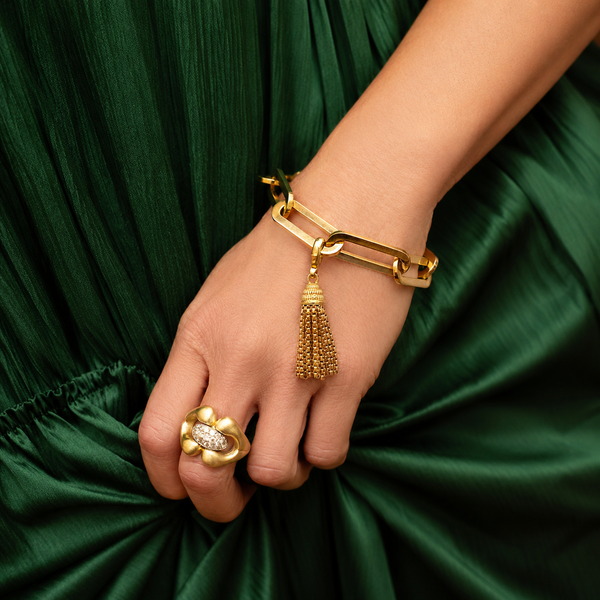
Fringe and beading introduce movement and texture into fine jewelry, offering an alternative to the static appearance of conventional settings.
Fine chains, articulated metal elements, delicate gemstone beads, and cascading details create pieces that respond to movement. The effect can be subtle, as in a delicate beaded necklace, or more dramatic, as in earrings with elaborate fringe.
This direction draws from historical jewelry traditions, particularly designs that emphasized ornamentation, craftsmanship, and the relationship between jewelry and movement.
Contemporary interpretations feel lighter and more versatile. Fine jewelry with fringe and beading can bring an element of evening glamour to an otherwise understated wardrobe.
10. Unconventional Materials and Carved Stone
The definition of luxury materials continues to expand. While diamonds, sapphires, emeralds, and rubies remain central to fine jewelry, designers are increasingly exploring stones for their color, texture, and sculptural potential.
Carved stone is an especially interesting expression of this direction.
Chalcedony and rose quartz, for example, offer distinctive translucency and soft color. Their surfaces can be polished, carved, or shaped into organic forms that emphasize the material itself.
Rather than relying exclusively on faceting, these designs explore volume, silhouette, and the natural qualities of the stone.
Unconventional materials bring a more artistic sensibility to fine jewelry. They also create opportunities for pieces that feel individual and difficult to categorize within traditional jewelry conventions.
11. Color-Stone Engagement Rings
Colored gemstone engagement rings continue to offer a compelling alternative to traditional diamond solitaires.
Sapphires, emeralds, spinels, tourmalines, and other precious gemstones introduce color and individuality into a category historically dominated by white diamonds.
The appeal is not simply aesthetic. A colored gemstone can create a more personal expression of style, whether through a saturated blue sapphire, a delicate pink stone, or an unusual combination of complementary colors.
Designs range from understated solitaire settings to elaborate vintage-inspired compositions featuring diamond accents.
For couples looking for unique engagement rings, color-stone engagement rings offer an opportunity to prioritize personal preference over convention.
12. Enamel Accents: Color and Craftsmanship
Enamel is returning as an expressive detail in contemporary fine jewelry.
Created by fusing powdered glass to a metal surface through heat, enamel can introduce saturated color, subtle gradients, and intricate decorative patterns.
Historically associated with important decorative objects and high jewelry, enamel has a long tradition in jewelry craftsmanship.
Contemporary designers are incorporating enamel accents into rings, bracelets, pendants, and earrings. The material can be used sparingly as a contrasting detail or more prominently as the defining feature of a design.
Enamel offers a way to introduce color without relying entirely on gemstones, making it particularly interesting in jewelry that balances traditional precious metals with more playful visual elements.
13. Black Rhodium Contrast
Black rhodium is an increasingly interesting finish for jewelry designers exploring contrast and dimension.
Applied as a surface treatment, black rhodium creates a dark metallic appearance that can emphasize the contours of a setting, outline individual stones, or introduce contrast against white diamonds and polished gold.
The effect is particularly striking in pieces with intricate detailing, pavé diamonds, and geometric compositions.
Rather than relying on the uniform brightness of traditional precious metals, black rhodium introduces shadow and depth.
It is a sophisticated detail for those drawn to jewelry with a slightly more unconventional, architectural, or dramatic aesthetic.
14. Jadeite Beyond Bangles: Lavender and Blue-Green Jade
Jadeite has a long history as a highly prized gemstone, particularly in Chinese jewelry and collecting traditions. While traditional jade bangles remain iconic, contemporary interest is expanding beyond the familiar bracelet silhouette.
Lavender jadeite and blue-green jadeite are especially compelling for their distinctive color variations.
Lavender jade offers a soft, almost ethereal appearance, while blue-green jadeite can range from delicate muted tones to vivid, saturated hues.
Designers and collectors are exploring jadeite in rings, pendants, earrings, and sculptural jewelry that emphasizes the stone’s natural character.
This broader interpretation of jadeite creates opportunities for pieces that connect traditional gemstone appreciation with contemporary design.
15. Warm-Toned Diamonds: Champagne, Blush, and Brown-Pink
White diamonds remain an enduring classic, but warm-toned diamonds offer a more nuanced expression of diamond jewelry.
Champagne, blush, and brown-pink diamonds have distinctive color profiles that create a softer alternative to traditional colorless stones.
Their appeal lies partly in their versatility. Champagne diamonds complement yellow and rose gold particularly well, while blush and brown-pink tones can create subtle, romantic compositions.
Warm-toned diamonds are especially interesting in engagement rings, earrings, and bespoke fine jewelry, where the stone’s individual color becomes part of the design.
For collectors interested in diamond jewelry with a more distinctive character, these hues offer a beautiful alternative.
16. Convertible and Modular High Jewelry
Versatility is becoming an important consideration in the design of exceptional jewelry.
Convertible and modular high jewelry explores how a single piece can be transformed, reconfigured, or worn in multiple ways. A necklace may become a bracelet. Detachable elements may create different earring silhouettes. A brooch may be incorporated into another composition.
This approach combines technical craftsmanship with thoughtful design.
The appeal is both practical and aesthetic. Rather than acquiring multiple pieces for different occasions, collectors can enjoy a more adaptable object with several expressions.
Convertible high jewelry also introduces a sense of discovery into the experience of wearing jewelry. Its value lies not only in the materials and workmanship but also in the ingenuity of its construction.
17. Bespoke Statement Pinky Rings
The pinky ring is experiencing renewed attention as a highly personal form of fine jewelry.
Historically associated with signet rings, family crests, and personal insignia, the pinky ring has a long tradition of communicating individuality and identity.
Contemporary interpretations are becoming more expressive. Bespoke statement pinky rings may incorporate substantial gemstones, sculptural gold forms, engraved details, or unusual proportions.
Unlike more conventional jewelry categories, the pinky ring offers considerable freedom in design. It can be understated and architectural or bold and ornamental.
Bespoke designs are particularly appealing because they allow the wearer to incorporate personal symbols, initials, family references, or meaningful gemstones.
The result is jewelry that feels less like an accessory and more like a personal signature.
18. Jewelry-Style Evening and Vintage Watches
The relationship between watches and fine jewelry is becoming increasingly fluid.
Jewelry-style evening watches bring together the functionality of timekeeping and the decorative qualities of fine jewelry. Vintage watches, particularly those featuring delicate proportions, precious-metal bracelets, diamond details, and unusual case shapes, are finding renewed appreciation.
These pieces occupy an interesting space between horology and high jewelry.
Rather than prioritizing the technical appearance of a conventional sports watch, jewelry-style watches emphasize elegance, craftsmanship, and ornamentation.
Vintage evening watches are particularly compelling because they often feature design details that are less common in contemporary mass-market watchmaking.
For collectors, they offer an opportunity to acquire something with both historical character and enduring aesthetic appeal.
19. Pink and Lavender Spinel, and Color-Change Garnet
Colored gemstones are becoming an increasingly important part of the fine jewelry conversation, particularly stones that offer unusual hues and optical characteristics.
Pink and lavender spinel are notable for their luminous colors and versatility. Depending on the stone, pink spinel can range from delicate pastel shades to intense, saturated pink, while lavender spinel offers a cooler and more understated appearance.
Color-change garnet introduces an entirely different dimension. Certain varieties display different colors under different lighting conditions, making them especially interesting to collectors who appreciate the unusual optical properties of gemstones.
These stones offer an alternative to more familiar precious gemstones and create opportunities for distinctive rings, earrings, and bespoke jewelry.
As interest in colored gemstones continues to develop, unusual varieties and individual stone characteristics are becoming increasingly important considerations.
20. Romantic Motifs with an Edge: Bombe Hearts, Reverse-Set Diamonds, and Keys
Romantic symbolism remains a powerful source of inspiration in fine jewelry, but contemporary interpretations are moving beyond conventional expressions of sentiment.
Bombe hearts, reverse-set diamonds, and key motifs introduce a more unexpected character to familiar romantic imagery.
Bombe hearts have a substantial, dimensional form that gives the traditional heart motif a sculptural presence. Reverse-set diamonds, mounted in an unconventional orientation, create unusual reflections and a more distinctive surface.
Keys introduce associations with mystery, intimacy, and personal meaning. In fine jewelry, they can function as decorative motifs or symbolic objects.
Together, these designs demonstrate how traditional romantic themes can be reinterpreted through unusual proportions, unexpected settings, and more expressive craftsmanship.
The result is jewelry that feels sentimental without being predictable.
What These Fine Jewelry Trends Reveal About Luxury in 2026
Taken together, the fine jewelry trends defining 2026 suggest a shift toward more individual forms of luxury.
There is greater interest in the character of a gemstone than in its conventional category. Antique-style diamonds are valued for their irregularity and history. Conch pearls are sought for their rarity and distinctive appearance. Colored gemstones offer a more personal alternative to traditional diamond jewelry.
Materials are also being reconsidered. Silver, enamel, carved stone, leather, and cord are finding their place alongside gold, platinum, and precious stones. Meanwhile, convertible high jewelry and bespoke statement pieces reflect an interest in craftsmanship that extends beyond appearance.
Perhaps the most important development is the growing emphasis on personal expression. Fine jewelry is increasingly approached as a collection of meaningful objects rather than a set of predictable wardrobe essentials.
For collectors and those building a jewelry collection, the most interesting pieces are often those that combine exceptional materials with an unmistakable point of view.
The future of fine jewelry is not defined by a single silhouette, gemstone, or aesthetic. It is defined by the freedom to combine tradition, craftsmanship, and individuality.
Frequently Asked Questions About Fine Jewelry Trends in 2026
What are the biggest fine jewelry trends for 2026?
The biggest fine jewelry trends for 2026 include cabochon diamonds, conch pearls, antique-style diamond cuts, Asscher-cut diamonds, colored gemstone engagement rings, sculptural silver cuffs, enamel accents, and convertible high jewelry. There is also growing interest in unconventional materials, bespoke jewelry, and vintage-inspired designs.
What diamond cuts are trending in 2026?
Diamond cuts attracting attention in 2026 include Asscher cuts, antique-style lozenge diamonds, cabochon diamonds, and historical cuts featuring chunky facets and open culets. These styles offer alternatives to conventional brilliant cuts, emphasizing geometry, character, and distinctive interactions with light.
Are antique-cut diamonds still popular?
Yes. Antique-cut diamonds remain appealing for their historical character, distinctive proportions, and less uniform brilliance. Old mine cuts, old European cuts, and other vintage-inspired diamond cuts are particularly attractive to collectors who appreciate craftsmanship and individuality.
What are the most popular engagement ring trends for 2026?
Engagement ring trends for 2026 include colored gemstone center stones, smaller center diamonds, classic trilogy rings, Asscher-cut diamonds, antique-style cuts, and warm-toned diamonds. Bespoke settings and unusual gemstone combinations are also important directions for couples seeking distinctive engagement rings.
Are colored gemstone engagement rings a growing trend?
Colored gemstone engagement rings offer an increasingly popular alternative to traditional white diamond solitaires. Sapphires, spinels, emeralds, and other gemstones allow couples to choose distinctive colors and designs that reflect personal taste.
What makes conch pearls so special?
Conch pearls are rare natural pearls produced by the queen conch mollusk. They are prized for their distinctive flame-like structure, porcelain-like appearance, and colors ranging from pale pink to coral. Unlike conventional cultured pearls, they cannot be commercially cultured in the same way, contributing to their rarity and desirability among collectors.
What is a cabochon diamond?
A cabochon diamond is a diamond polished into a smooth, rounded or domed surface rather than cut into traditional facets. Its appearance is generally softer and more subdued than that of a brilliant-cut diamond, emphasizing shape and surface rather than conventional sparkle.
What are warm-toned diamonds?
Warm-toned diamonds are diamonds with naturally occurring hues such as champagne, blush, and brown-pink. They offer a softer alternative to colorless diamonds and are often paired with yellow gold and rose gold settings.
What is the difference between an Asscher cut and an emerald cut?
Both Asscher and emerald cuts are step cuts, meaning their facets are arranged in parallel, linear patterns rather than the triangular facets of brilliant cuts. An Asscher cut is generally square with cropped corners, while an emerald cut is rectangular and elongated. Both emphasize clarity, symmetry, and geometric depth.
What is modular high jewelry?
Modular high jewelry consists of pieces designed to be rearranged, detached, or transformed into different configurations. Examples include necklaces that convert into bracelets, earrings with removable components, and brooches that can be incorporated into other designs.
Is jadeite fashionable beyond traditional bangles?
Jadeite is being explored in a wider range of jewelry designs beyond traditional bangles. Lavender and blue-green jadeite are particularly distinctive colors, and the gemstone can be incorporated into rings, pendants, earrings, and sculptural statement pieces.
What gemstones are worth watching in 2026?
Gemstones worth watching include pink and lavender spinel, color-change garnet, conch pearls, jadeite, chalcedony, rose quartz, and warm-toned diamonds. Their appeal comes from distinctive colors, rarity, optical characteristics, and versatility in contemporary jewelry design.
How should you choose fine jewelry that will remain timeless?
Look for exceptional materials, thoughtful proportions, strong craftsmanship, and designs that resonate with your personal style. Classic diamond shapes, well-made gold jewelry, distinctive colored gemstones, and historically inspired designs can all have enduring appeal. Rather than following every trend, prioritize pieces you will enjoy wearing and collecting over time.
What is the difference between fine jewelry and high jewelry?
Fine jewelry generally refers to jewelry made with precious metals and genuine gemstones, including gold, platinum, diamonds, and precious or semiprecious stones. High jewelry, or haute joaillerie, typically refers to exceptional, often one-of-a-kind creations involving rare gemstones, extraordinary craftsmanship, and highly complex design. The distinction is not always strictly defined, but high jewelry generally occupies a more exclusive category.
Discover More from Exhibea
At Exhibea, we work with fine jewelry, luxury fashion, and lifestyle brands to create distinctive digital experiences that bring their craftsmanship, identity, and collections into focus.
From brand strategy and art direction to bespoke Shopify commerce experiences, we help jewelry businesses translate the value of their products into compelling brand worlds and commercially effective digital destinations.
Explore our work and discover how we help luxury brands build their next chapter.